

See What a Visual Inspection Can’t
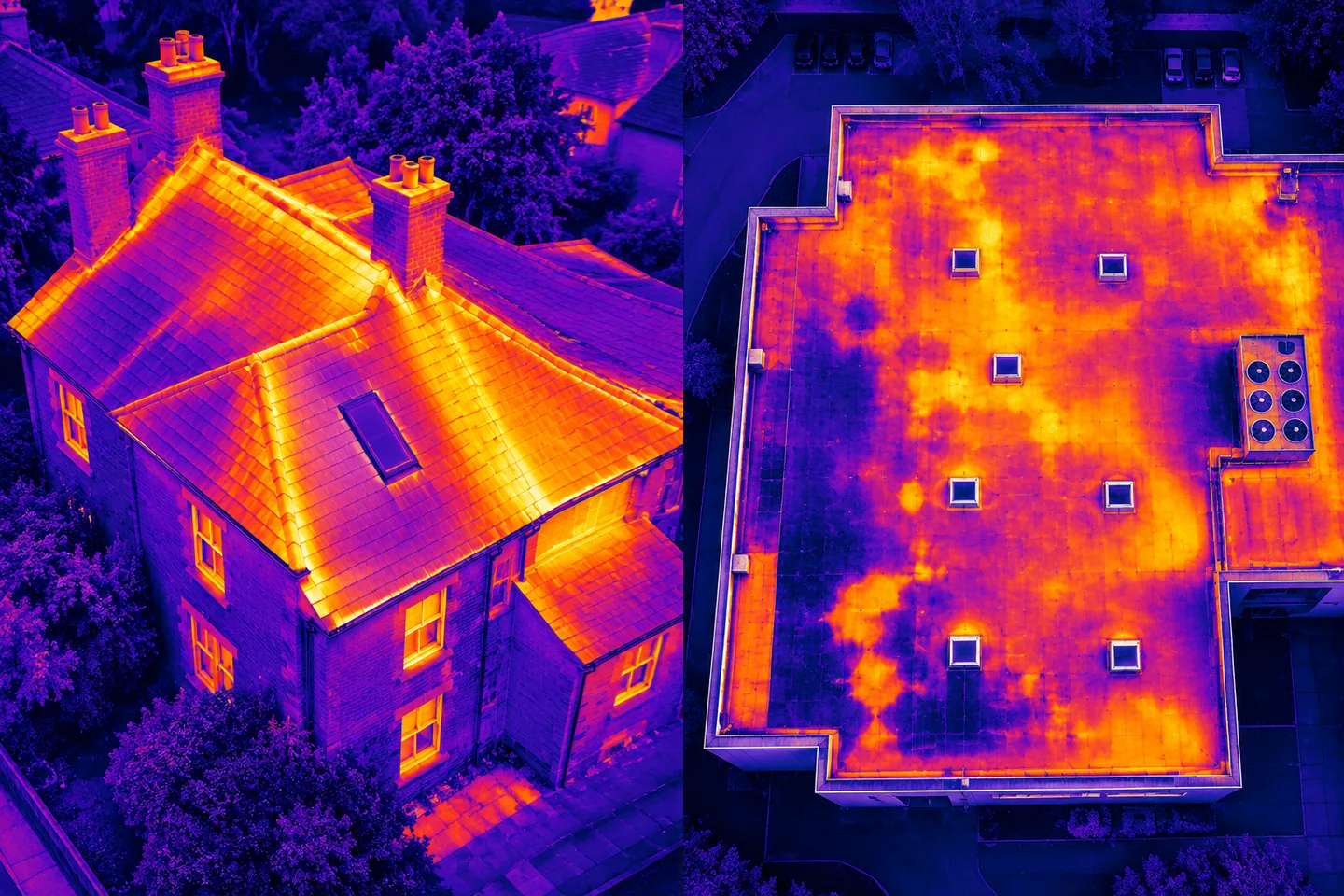
Thermal imaging reveals patterns of heat that are invisible in normal photography, providing additional information about roofs, buildings, solar installations and other assets.
Thermal drone surveys across the UK.
 CAA-Qualified Pilots · PDRA01‑27664 From terraced houses to the Houses of Parliament
The value of thermal imaging
Choosing the Right Tool for the Problem
Modern drones can capture many different types of information, from detailed 4K video and still imagery to thermal data, mapping and 3D models. At Roof Hawk, we start with the question you need to answer and the information that will help you answer it, then choose the most appropriate way to capture it.
Thermal imaging has a particularly valuable role where differences in temperature can reveal patterns and potential problems that aren’t visible to a normal camera, across roofs, building fabric, solar installations and other assets.
As RICS puts it:
“It is the data that you need, and drones are the facilitator for the data.”
When thermal imaging adds value
See More Than a Visual Inspection Alone
Not every inspection needs thermal imaging, but in the right situation it can add a completely different layer of information.
Read more
Thermal cameras reveal differences in surface temperature that aren’t visible to the eye. Those patterns can help identify areas associated with heat loss, missing or incomplete insulation, thermal bridging, moisture, abnormal electrical heating or underperforming solar equipment.
That additional information can help focus further investigation and maintenance on the areas most likely to need attention.
RICS: An introduction to building thermography
From thermal patterns to useful evidence
Focus Attention Where It Matters
Instead of treating a whole roof, façade or solar array in the same way, thermal imagery can highlight areas behaving differently from their surroundings.
For a property or asset team, that might mean focusing further investigation on a particular part of a roof, identifying areas of building fabric associated with heat loss or moisture, or locating an electrical component showing unusual heat.
For a solar installation, thermal imagery can rapidly identify modules or areas showing abnormal temperature patterns so the appropriate specialist can investigate further.
The practical value is being able to focus time, access and further investigation on the areas most likely to need attention.
Common thermal imaging applications
Roofs, Buildings, Solar and Infrastructure
Roofs and water ingress
Where the cause of water ingress is not obvious from visual imagery alone, thermal imaging can provide additional evidence by identifying temperature patterns associated with moisture or affected materials.
This can be particularly useful across larger or difficult-to-access roof areas because it can help narrow down where further investigation should be focused.
Thermal imagery does not directly “see” water, and suspected dampness may need to be confirmed using other methods. The value is in adding another layer of evidence to the investigation.
Building fabric and heat loss
Thermal imaging can help identify patterns associated with missing or incomplete insulation, thermal bridging and air leakage.
This can make otherwise invisible differences across walls, roofs and other parts of the building fabric easier to locate and investigate.
CIBSE/BSRIA guidance recognises thermal imaging as an established method for assessing continuity of insulation and locating air-leakage paths in completed buildings.
Solar PV
Solar is one of the strongest applications for aerial thermal imaging.
A drone can inspect large rooftop or ground-mounted arrays efficiently and identify modules or cells showing abnormal thermal patterns associated with potential faults or underperformance.
IEA-PVPS notes that aerial infrared inspection can detect a range of PV failure types and that thermal signatures can help maintenance teams locate and classify faults.
Where a project requires a particular technical methodology or specialist interpretation, tell us when you enquire so the survey and reporting can be scoped appropriately.
Electrical and infrastructure assets
Abnormal heating can be an important indicator across electrical and mechanical assets.
Aerial thermal capture can help locate hotspots across assets that are extensive, elevated or otherwise inefficient to inspect from the ground, helping specialist teams focus their follow-up work.
Read more
Sources: CIBSE/BSRIA Thermal Imaging of Building Fabric (BBG39/11)IEA-PVPS review of IR and EL imaging for PVNetwork Rail Air Operations
How thermal imaging works
Turning Invisible Temperature Differences Into a Clearer Picture
A thermal camera detects infrared radiation emitted from surfaces and represents differences in apparent surface temperature as an image.
The colours make those differences easy to see, but the important information is the pattern of temperature across the asset, not the colour itself.
The conditions at the time of capture matter. Weather, wind, sunlight, the temperature difference between inside and outside a building, surface materials and the time of day can all influence what appears in the imagery.
That is why the survey should be planned around the question being investigated rather than simply flying a thermal camera over the site.
A thermal anomaly can tell us where to look more closely. Its significance then depends on the building or asset, the conditions and the wider evidence.
Useful outputs
Thermal Imagery You Can Actually Use
The exact deliverables depend on what the survey needs to achieve.
Typically, this can include detailed thermal imagery of the areas surveyed together with high-resolution visual imagery, allowing temperature patterns to be understood in the context of the actual roof, building or asset.
Where required, we can also arrange:
- radiometric thermal files containing temperature data;
- annotated imagery highlighting areas of interest;
- comparison between thermal and standard visual imagery;
- specialist interpretation or reporting;
- outputs structured around a particular maintenance, surveying or engineering requirement.
We agree the useful output before the survey so you receive information that supports the decision or investigation you are undertaking.
Specialist capture, managed simply
Tell Us What You Need to Understand
You do not need to know which camera, file type or thermal methodology you need before contacting us.
Read more
Tell us about the building or asset, what you are trying to understand and how the information will be used. We can help scope the survey, plan the thermal capture and provide the imagery required.
Where the project needs specialist interpretation, we can also arrange expert review of the thermal imagery and appropriate reporting. This can be important because the significance of a thermal pattern depends on the building or asset, the conditions at the time of capture and the wider evidence.
Roof Hawk provides specialist commercial drone services across the UK, using skilled pilots and advanced thermal-imaging drones alongside high-quality visual cameras. We plan the capture around the question being investigated and take care of flight planning and restricted-airspace requirements where needed.
Thermal imaging questions
A Few Useful Things to Know
Is thermal imaging useful for roofs?
Yes. Thermal imaging can be particularly useful where you are investigating moisture, insulation performance, heat loss or an issue that is not clearly visible in normal imagery.
It can also be useful across larger flat roofs, where identifying areas of unusual thermal behaviour can help focus further investigation.
Whether it adds value depends on the roof construction, the question being investigated and the conditions at the time of the survey. We can help you work out whether thermal capture is appropriate for your project.
Can thermal imaging help investigate a roof leak?
Yes. Where the source of water ingress is not obvious visually, thermal imaging can provide additional evidence by identifying temperature patterns associated with moisture or affected materials.
This can help narrow down areas for further investigation, particularly across larger or difficult-to-access roofs.
Thermal imagery should be interpreted alongside the building, weather conditions and other evidence. Where dampness is suspected, further testing may be appropriate.
Can you inspect solar panels?
Yes. Solar is one of the strongest applications for aerial thermal imaging.
A drone can inspect large arrays efficiently and identify modules or cells showing abnormal thermal patterns associated with potential faults or underperformance. This can help maintenance teams focus further testing or remedial work on the areas that need attention.
If the project requires specialist electrical interpretation or a particular technical methodology, tell us when you enquire so we can scope the correct approach.
What do I receive?
You will receive detailed thermal imagery of the areas surveyed, normally alongside high-resolution visual imagery so the thermal patterns can be understood in the context of the actual building or asset.
Depending on the project, we can also arrange annotated outputs, radiometric files, analysis or specialist interpretation and reporting.
Do you work across the UK?
Yes. Roof Hawk provides thermal drone surveys for buildings, roofs, solar installations and other commercial assets across the UK.
We take care of the flight planning and any restricted-airspace requirements as part of the project.
More on this: Commercial drone roof surveysRoof leak inspection3D mapping and photogrammetryConstruction monitoring and mapping
“Excellent service with a very quick response and a professional approach throughout. The quality of the drone footage was outstanding, capturing the roof in exceptional detail.”
Start with the question
Could Thermal Imaging Help Your Project?
Tell us what you are trying to understand, where the building or asset is and what decision the survey needs to support.
We can help work out whether thermal imaging is the right approach and what information will be most useful.